Building My Own AI Health Coach: A 12-Week Journey
I’m building my own AI health coach — not because I need another app, but because I want to be hiking the hard trails when I’m 60. Here’s how it started.
Last week, I was hiking up a rocky trail in the Smoky Mountains, legs burning, heart pounding. Halfway up, I stopped to catch my breath and thought: I want to be able to do this when I’m 60.
Not shuffle up the easy path. Not watch from the parking lot. I want to tackle the hard trails with the same strength and energy I have now in my late 30s.
That moment sparked something. I’m building an AI-powered health app—from scratch—to help me get there. Not someday, but starting today. This will be a personal, private 12-week journey.
Why Build This Myself?
The Information Maze
Ever feel like health advice is just contradictory noise?
- Low-carb diets are either miraculous or dangerous depending on who you ask
- Intermittent fasting will either optimize your metabolism or destroy it
- Coffee is simultaneously a longevity elixir and an anxiety trigger
Even peer-reviewed studies contradict each other. One randomized control trial says X, another says the opposite. How do you separate genuine insights from correlation-not-causation hype?
I’m done guessing. I want an AI that can process thousands of studies and help me separate fact from hype.
When Doctors Treat Symptoms, Not Root Causes
Here’s my wake-up call: in my mid-20s, I was diagnosed with Graves’ disease—an autoimmune condition often triggered by poor diet and chronic stress. The specialist recommended thyroid removal: immediate, permanent, irreversible.
Something felt off. I got a second opinion and learned there were other options. Instead of surgery, I focused on the root causes—stress management, proper nutrition, and better sleep.
Fast forward: my thyroid is normal. No surgery. The autoimmune condition is resolved.
That experience taught me one big lesson: medical advice isn’t always personalized—it’s often standardized.
Another example: a friend went to her doctor with one high cholesterol reading. The doctor immediately suggested statins. No questions about hormones, no follow-up test, no deeper investigation into why.
Blood tests are snapshots.
Health isn’t a snapshot — it’s a trend.
That’s why I’m a big believer in continuous monitoring and regular lab work. The more data points you have, the clearer the picture.
I’m not anti-medicine — I’m pro-root-cause-analysis. And I’m tired of generic advice that doesn’t account for my biology, lifestyle, or data.
What LLMs Can Do That I Can’t
Here’s what excites me about AI: the ability to process massive amounts of research and find patterns I’d never see on my own.
Imagine an AI that can:
- Analyze thousands of randomized control trials
- Cross-reference findings with my personal health data
- Filter out hype and correlation-not-causation junk
- Give me personalized recommendations based on my biomarkers
That’s the goal. Not to replace doctors, but to give myself better tools to ask smarter questions and make informed decisions.
A Technical Adventure (With AI as My Copilot)
Confession time: I’m a backend developer. Frontend? Basically a tourist with a map and no sense of direction.
But that’s part of the fun. This project is as much about health as it is about learning to use AI to 10x my learning speed.
I’m building this with Next.js and deploying on Vercel, using AI as my coding copilot to learn React, TailwindCSS, and everything else I’ve avoided until now.
If this works, it could reshape how we learn new technical skills.
What I’m Building
A full-stack AI health companion that helps me understand and improve my health through data and dialogue.
Here’s what it’ll do:
- 📊 Track biomarkers — spot patterns and trends over time
- 🧠 Chat with your data — get insights from uploaded research and lab results
- 🎯 AI habit challenges — gamify healthy behavior change
- 🧾 Document upload + RAG — build a personal health knowledge base
- 🔗 Data integrations — connect Apple Health, glucose readings, ketone strips
- 💬 LLM insights — cut through the noise of conflicting studies
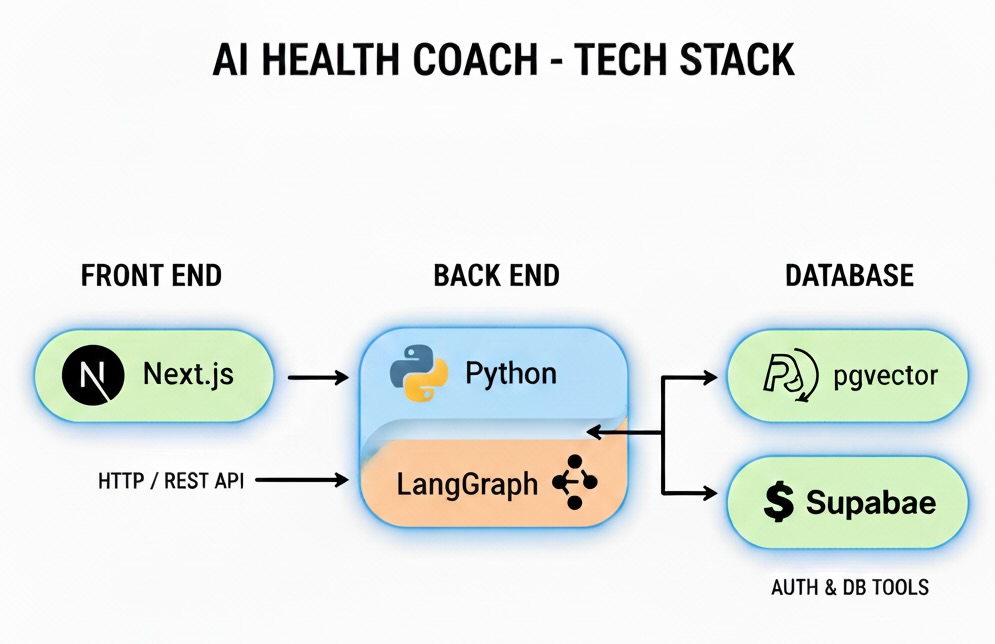
Tech stack: Next.js, LangGraph, pgvector, Supabase
The 12-Week Plan
8 hours per week. Real-world constraints. No shortcuts.
- Weeks 1–2: Frontend crash course (Next.js, React, TailwindCSS)
- Weeks 3–5: Auth, database, and backend setup
- Weeks 6–7: LLM integration and chat UI
- Weeks 8–9: RAG pipeline and document management
- Weeks 10–12: Polish, test, deploy
Why You Should Care
If you’ve ever:
- Felt overwhelmed by conflicting health advice
- Questioned whether your doctor’s recommendation was really the best
- Wanted to make sense of your own lab results
- Or simply want to take more control over your long-term health
Then this project is for you too.
We all deserve better tools to understand our health.
The medical system won’t hand us transparency — so let’s build it ourselves.
Here’s to hiking those hard trails in our 60s. 🏔️
Week 1 starts this week. 12 weeks. 8 hours a week. Let’s see what happens.
